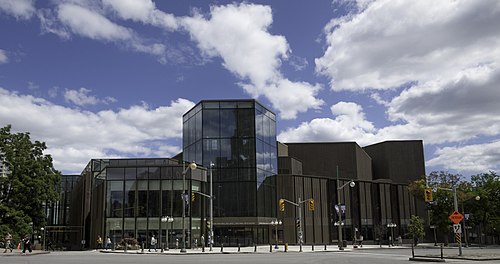
Great Hall of the Moscow Conservatory
Russia's best-known concert hall, opened in 1901 with a Cavaille-Coll organ and 1,737 seats.
The Moscow Conservatory was founded in 1866 by Nikolai Rubinstein, and Pyotr Tchaikovsky taught there from its first year. Its Great Hall was built to designs by Vasily Zagorsky and opened on 7 (20) April 1901. Zagorsky kept the semi-rotunda facade of the eighteenth-century house that stood on the site, built for Princess Yekaterina Dashkova, and set the new auditorium behind it. Much of the fitting out was paid for by Moscow merchant patrons.
The auditorium seats 1,737 and is admired above all for its acoustics. Behind the platform stands the organ built by Aristide Cavaille-Coll of Paris in 1899, shown at the Paris World Exhibition of 1900 before being installed in Moscow. Oval portraits of composers line the walls. The hall served as a military hospital between 1915 and 1917 and as a cinema by day from 1924 to 1933; a monument to Tchaikovsky was placed in front of it in 1954. It hosts the International Tchaikovsky Competition.
Highlights
- Cavaille-Coll organ of 1899, first played in the hall in April 1901
- Auditorium of 1,737 seats known for its acoustics
- Semi-rotunda facade kept from the eighteenth-century Dashkova house
- Principal venue of the International Tchaikovsky Competition