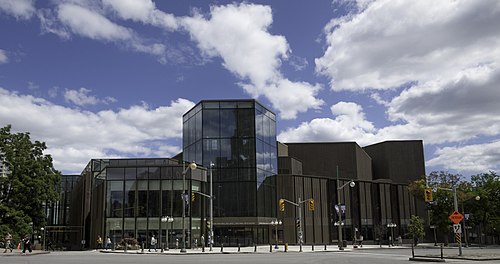
National Centre for the Performing Arts
Paul Andreu’s titanium-and-glass “Egg” housing an opera house, concert hall and theatre.
The National Centre for the Performing Arts stands just west of Tiananmen Square and the Great Hall of the People, on West Chang'an Avenue in central Beijing. Designed by the French architect Paul Andreu, it was built between 2001 and 2007 and opened to audiences in December 2007. Its most recognisable feature is a vast ellipsoid dome of titanium panels and glass, which has earned it the popular nickname 'the Giant Egg' among residents and visitors alike.
The dome measures roughly 212 metres from east to west and is surrounded by a shallow artificial lake, so the building appears to float on its own reflection. Visitors enter through a glass-roofed passage running beneath the water. Inside, a single shell covers several separate venues: the Opera House, the Concert Hall, the Theatre and a smaller Multi-functional Theatre, together seating more than 5,000 people, alongside exhibition spaces and public foyers.
The centre is both a presenting house and a producer. It stages its own opera, drama and dance productions, and is home to the China NCPA Orchestra and the NCPA Chorus. Its programme combines Western opera and symphonic repertoire with Peking opera, Chinese traditional music and contemporary works, and it regularly hosts touring orchestras and companies from abroad. Public lectures, education programmes and exhibitions take place throughout the year.
Highlights
- Titanium-and-glass ellipsoid dome designed by Paul Andreu
- Reflecting lake crossed by an underwater entrance corridor
- Opera House, Concert Hall, Theatre and Multi-functional Theatre under one roof
- Home of the China NCPA Orchestra and in-house opera productions
- Central location beside Tiananmen Square and the Great Hall of the People