
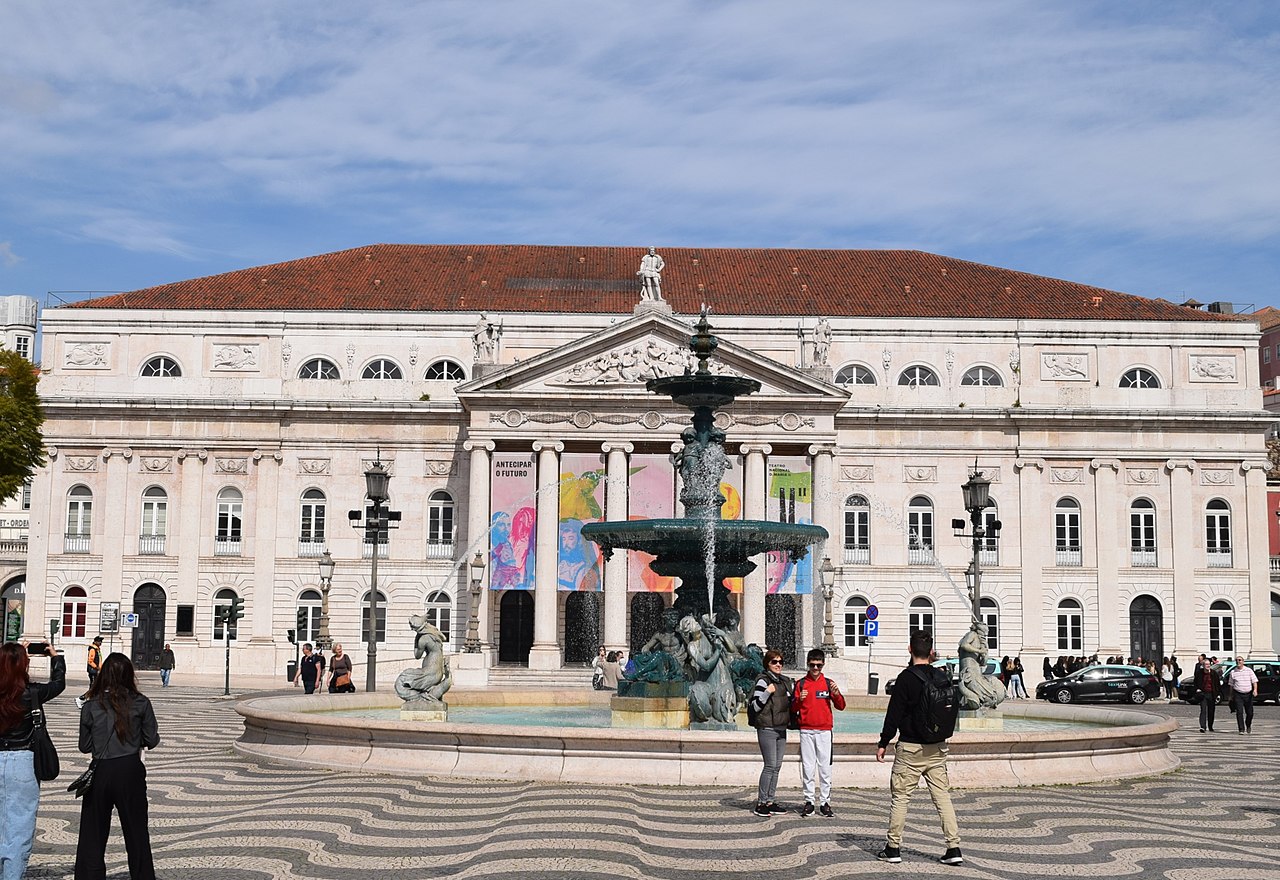
Dona Maria II National Theatre
Portugal's national theatre on Rossio square, reopened in September 2026 after a three-year refurbishment.
Portugal's national theatre stands on the north side of Rossio, on the site of the Estaus Palace, which had housed the Inquisition. Built between 1842 and 1846 to designs by the Italian architect Fortunato Lodi, it is a neoclassical block fronted by a six-column Ionic portico taken from the demolished convent of São Francisco. The pediment carries a statue of Gil Vicente, the sixteenth-century playwright regarded as the founder of Portuguese theatre, and the main auditorium is named after the dramatist Almeida Garrett.
A fire gutted the building in 1964 and it stayed shut until 1978, when the interior was rebuilt behind the surviving façade. The theatre closed again in 2023 for a rehabilitation, restoration and modernisation programme funded through Portugal's Recovery and Resilience Plan, and reopened in September 2026. It now runs the Sala Garrett and the smaller Sala Estúdio, together with the Salão Nobre, an exhibition gallery, a bookshop and a library and archive.
Highlights
- Ionic portico reusing columns from the convent of São Francisco
- Statue of the playwright Gil Vicente crowning the pediment
- Sala Garrett and Sala Estúdio auditoriums with year-round drama
- Guided tours of the rebuilt backstage areas


